
Pigeonberry
Rivinia humilis
Family: Petiveriaceae
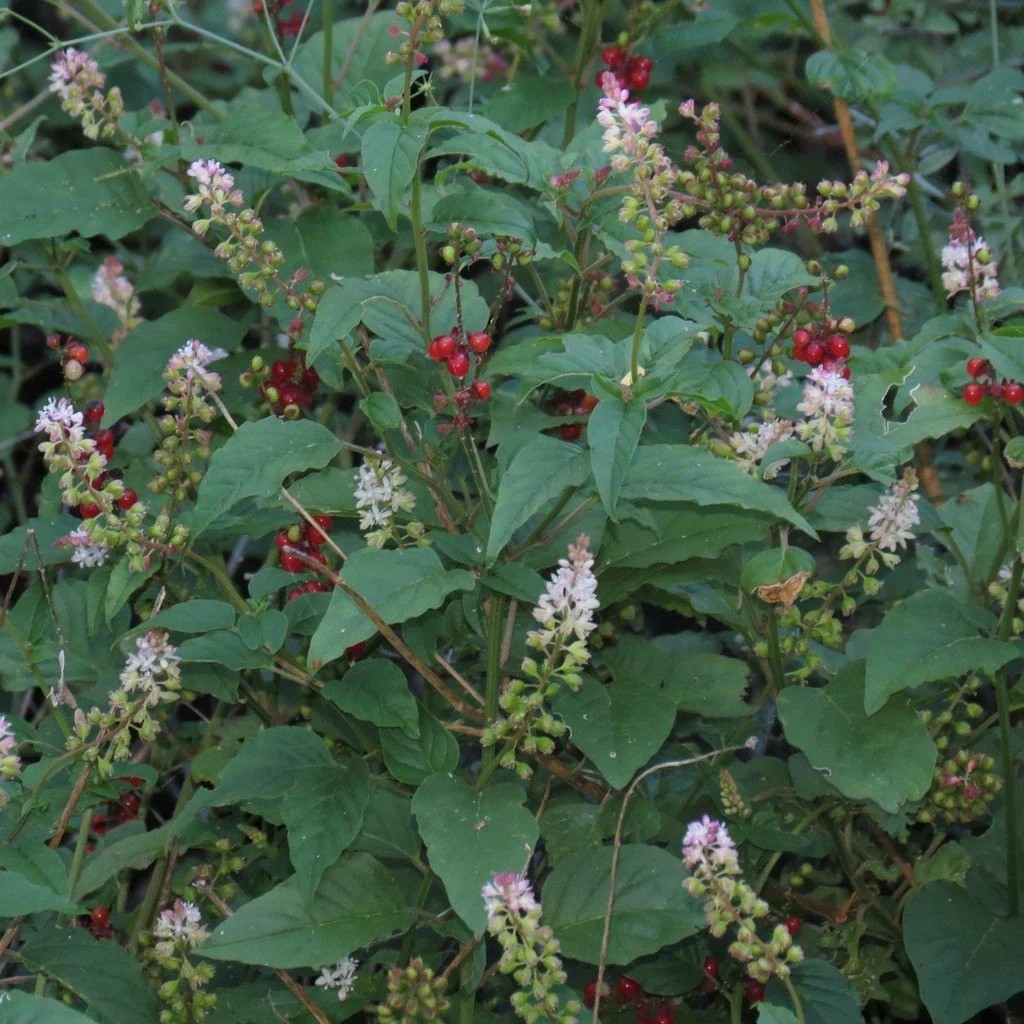
Herbaceous perennial usually with evergreen foliage (though young plants can sometimes go dormant with cool weather). Plants usually grow to 3’ tall but can reach 6’, often scrambling up inside trees or other shrubs. White to pink inflorescences develop into bright red berries.
Best in part sun or even full shade, with moderate to regular water. This plant appreciates some amended soil. Hardy at least into the single digits °F.
Many small pollinators use the flowers. The fruits are used by many fruit-eating birds. Larval host for the Goodson's Greenstreak (Cyanophrys goodsoni) which occurs in the very southern tip of Texas south through Mexico to Costa Rica.
The fruits are used as a dye. The berries are not edible for people. In Mexico, the leaves are employed to treat wounds. In Jamaica, women use this herb is used for the cleaning of a “blocked tube”, in other words, for infertility or any womb related problem, the herb is also used for menstruation flow problem. By some, the foliage is sometimes boiled and consumed as a tea three times daily for problems with infertility and other womb related problem.
The genus Rivina, which has two species, is named in honor of German botanist Augustus Quirinus Rivinus (1652-1723). The species name, humilis, means low-growing or humble.
Rivina humilis can be found in forests, thickets, shell middens, hammocks, roadsides, and disturbed areas at elevations from sea level 5,600 ft. in southern North America from Florida to Arizona, north to Oklahoma and Arkansas, south through Central America and the Caribbean to tropical South America.