
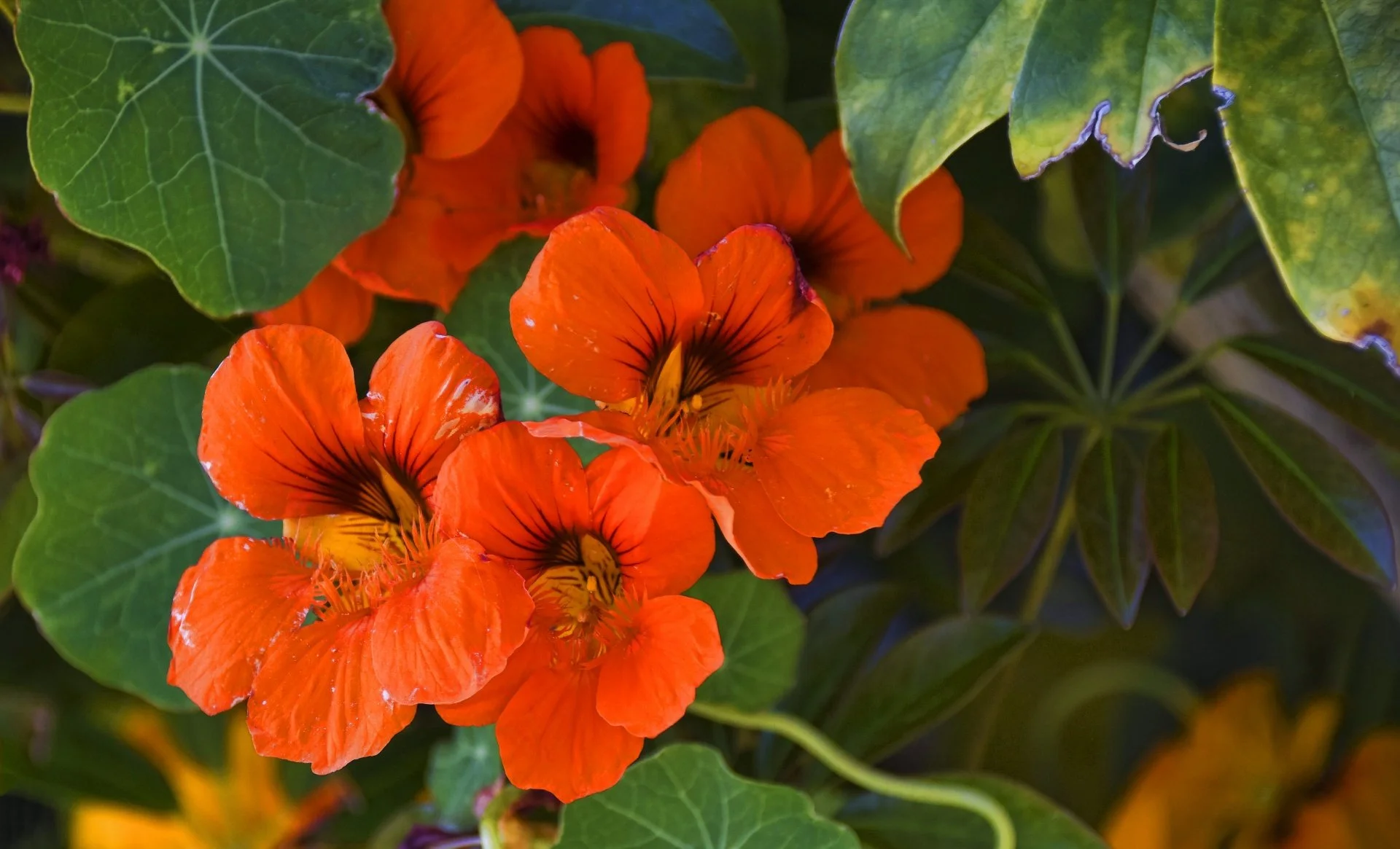
Tangy Naturtium
Tropaeolum majus
Family: Tropaeolaceae
COOL SEASON ANNUAL GREEN
This species is grown for its ornamental value as well as for a spicy addition to salads, and for its edible flowers. It is a classic garden plant and relatively easy to grow in the cooler and balmy seasons in our region.
Nasturtium leaves, like some other species, demonstrate the lotus effect, whereby rainwater falling on the surface gathers into globular droplets which roll off the leaf, leaving it dry and clean.
HISTORY
This species, and other species in the genus Tropaeolum, is native to South America where it was an important food for the people of that region, especially the tuberous-rooted Tropaeolum tuberosum. In the 1500s, the Spanish brought a smaller, yellow-flowering species to Europe, and eventually this species also made its way to Europe, where it quickly became a favorite.
USES
Garden nasturtium is mostly used raw in salads, and as a garnish (both the leaves and the flowers). Green nasturium seeds are pickled as a sort of caper. The leaves are sometimes folded into stirfry, lightly cooked.
Some native South Americans use the plant medicinally, apparently due to its antibiotic (including antibacterial) properties. Some Europeans eat it to treat urinary and genital infections.
Here are three garden nasturtium recipes.
PRESERVATION
The green seeds are pickled as a kind of caper.
GROWING
SEASON & PLANTING
This species doesn’t like our hot summers. It can be started in fall, and protected from hard frosts, or started in spring to be grown until it gets hot, lasting into May. Plants can be planted from direct seeding (which is easy due to their large seeds) or from nursery starts.
SOIL & NUTRITION
Plant in amended garden soil. This plant is not demanding but doesn’t mind an occasional feeding with a general purpose organic fertilizer.
TEMPERATURE & SUN EXPOSURE
Grow this in part to full sun, or even bright shade—morning sun with afternoon shade is probably the best location for this species. Plants in part or filtered sun will last longer into the warm season. Protect plants from hard frosts.
WATER
This plant wants consistent, even moisture.
HARVESTING
Use leaves and flowers as needed. If pickling the seeds, pick them when they are still green and soft.
WILDLIFE
The garden nasturtium is used as a food plant by the larvae of some lepidopteran species including the dot moth (Melanchra persicariae), the garden carpet moth (Xanthorhoe fluctuata) and the large white or cabbage white butterfly (Pieris brassicae).
INVASIVENESS
This plant does not pose a threat in our region.
POPULAR SELECTIONS
There are too many selections to list here. Most selections feature a specific flower color scheme.
NOTE: There are other plants sometimes called “nasturtium” including what is better called watercress (Nasturtium officinale). Because the genus is called Nasturtium, this can sometimes be confusing.